DDR5 Server DRAM Supply Gap Through 2027: The AI Server Memory Configuration Math
The server-memory shortage is not explained by counting AI accelerators alone. It is also a configuration problem: how many host systems are deployed, how much working memory each requires, which modules are qualified, and how quickly manufacturers can deliver the appropriate mix.
That makes DDR5 a distinct part of the AI infrastructure story. HBM supports accelerator bandwidth, while conventional server DRAM supports host software, data preparation, databases, and other system functions. One does not eliminate the need for the other.
The outlook remains tight but conditional. A July 2026 industry forecast expected HBM allocation, server demand, and delayed production ramps to constrain DRAM supply through 2027. It also anticipated that meaningful output from some new capacity would arrive only in the second half of that year. Those expectations describe a forecast, not a guaranteed shortage of every DDR5 configuration.
The analytical key is configuration: translate deployment plans into qualified memory requirements before comparing them with supply.
Start with the Right Unit of Demand
A server shipment is not a standard quantity of DDR5. Different systems carry different processor counts, memory channels, module capacities, and population arrangements.
Some workloads need large memory capacity. Others emphasize bandwidth, balanced channel population, or a particular price-performance point.
That variation makes an average useful only when its underlying mix is understood. Combining small enterprise servers with large AI hosts can conceal the configurations responsible for the strongest demand.
For analysts, the first step is a segmentation exercise. Separate server classes, estimate their shipment volumes, and assign a realistic memory configuration to each. The resulting demand model is more informative than multiplying all servers by one headline capacity.
The Basic Capacity Equation

Total installed DDR5 capacity can be estimated by multiplying server shipments by average DDR5 capacity per system, then adding relevant upgrades and replacements.
A second formulation works from modules: systems multiplied by populated slots per system, multiplied by capacity per module.
The two approaches should agree when the assumptions are consistent. Neither captures every purchasing detail, such as spare inventory or modules procured ahead of deployment.
They provide a useful foundation, however. Once the model is explicit, an analyst can test how shipment growth, larger modules, or changes in population affect demand instead of treating memory content as an unexplained adjustment.
An Illustrative Configuration Shows the Scale
Consider a hypothetical server with sixteen populated slots using 64GB modules. Its installed capacity is 1,024GB, approximately one terabyte in the module-capacity convention.
If the same population moves to 96GB modules, capacity becomes 1,536GB—a 50% increase without changing the number of servers or occupied slots.
At 128GB per module, the same arrangement reaches 2,048GB, twice the original capacity.
These are arithmetic examples, not universal AI-server specifications. Their significance is that memory-content changes can create substantial demand independently of unit growth. The model must identify whether customers actually adopt those configurations.
Shipment Growth and Content Growth Compound
Suppose shipments in a defined server segment increase 15%, while average DDR5 capacity rises 20%. Installed capacity demand would increase approximately 38%, not 35%, because the two changes multiply.
This hypothetical calculation excludes upgrades, inventory movements, and changes in product mix. It demonstrates the mechanism rather than forecasting a specific market result.
The compounding can be powerful, but it can also reverse. If higher prices cause customers to reduce average memory content, shipment growth may produce less bit demand than expected.
For investors, the most useful forecast therefore separates the two assumptions. An optimistic unit forecast should not automatically carry an equally optimistic content forecast without evidence for both.
AI Hosts Need Memory Outside the Accelerator
Accelerator memory supports selected computational operations, but the host system still runs software and manages data movement.
Working memory can support data preparation, application services, database activity, and other functions around the accelerator workload.
The requirement depends on the design. A training system, inference service, and retrieval-heavy application can create different demands on host DRAM.
This is why accelerator counts alone are insufficient. The relevant model connects accelerators with the associated host configuration, workload, and supporting infrastructure. Otherwise, it can either overlook conventional memory demand or assume more than the application actually requires.
Rack-Scale Systems Complicate the Denominator

AI infrastructure is increasingly discussed in racks, nodes, trays, and clusters. Those terms are not interchangeable with a conventional server count.
A rack-scale deployment can distribute compute and memory across several connected elements. Public descriptions may emphasize accelerator quantities while leaving host-memory details less visible.
For analysts, the solution is to define the system boundary. Specify which components are included, how many memory-bearing hosts are present, and what capacity belongs to each.
A clean denominator prevents double counting. It also makes comparison across architectures possible without assuming that every rack or node contains the same amount of DDR5.
Capacity and Bandwidth Can Pull Configurations Differently
A customer may populate memory channels to achieve bandwidth rather than simply reach a capacity target. Another may select larger modules because the working set is too large.
Those objectives can produce different purchasing mixes even when total capacity is similar.
Module rank, population, processor support, and operating speed also interact. Adding capacity does not guarantee an equivalent improvement in bandwidth or application performance.
From a system engineer’s perspective, the configuration must satisfy the workload and platform rules. From a memory supplier’s perspective, that creates demand for particular qualified products—not an unrestricted market for any available DRAM bits.
High-Capacity Modules Create Specific Supply Requirements
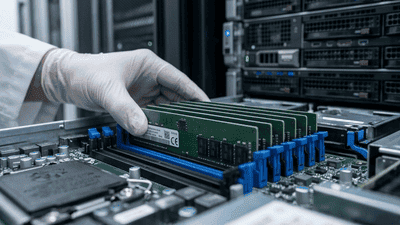
Server modules combine DRAM with additional components, board design, programming, assembly, and testing. Their availability cannot be inferred solely from total chip output.
A supplier can have adequate capacity for one module density while another remains constrained. Customer approval can further narrow the usable pool.
This creates a gap between aggregate DRAM supply and supply of the configurations customers want.
For procurement teams, the relevant question is the delivery of approved modules in the required quantities. For investors, the opportunity lies where a manufacturer can consistently supply those products at attractive economics.
HBM Allocation Adds Pressure Without a Fixed Conversion Rule
HBM and conventional DRAM compete for some manufacturing resources, investment, and development attention. Strong HBM demand can therefore influence the supply available to other advanced products.
However, it is misleading to assume that every additional HBM unit removes one defined quantity of DDR5. Architecture, process technology, yield, and production arrangements affect the relationship.
The practical analysis follows manufacturer allocation decisions and accepted output rather than a universal wafer penalty.
For 2027, the relevant question is whether qualified conventional DRAM expands fast enough alongside HBM commitments. A strong investment budget can support both while still leaving near-term shortages if the ramp is gradual.
New Capacity Has Several Arrival Dates
A factory announcement establishes a plan. Construction completion establishes a facility. Equipment installation creates manufacturing capability. Qualification and yield improvement determine commercially useful output.
Those stages can be separated by substantial time, which limits how quickly supply responds to higher prices.
The same distinction applies to technology transitions within existing facilities. Potentially denser output becomes useful only when production and customer acceptance are stable.
For analysts, supply forecasts should use expected qualified bit output, not nominal wafer capacity alone. That is the closest comparison with the memory demand generated by actual system configurations.
Buyers Can Reduce Content When Prices Rise
The configuration trend is not permanently upward. Customers can revisit specifications when memory costs increase.
Reported 2026 adjustments included cloud providers and OEMs moving selected systems from 96GB or 128GB modules toward 32GB or 64GB configurations. That observation concerned particular purchasing changes, not a universal reduction in memory across every server.
This introduces demand elasticity into the model. Buyers may preserve deployment volume while changing the amount of memory installed.
For an investor, that is an important counterweight to a shortage thesis. Higher prices can improve near-term revenue while encouraging customers to moderate the very content growth supporting demand.
NAND and Enterprise SSDs Share the System Budget
Servers also need persistent storage. NAND-based SSDs hold operating data, databases, checkpoints, and other information that must survive power removal.
DDR5 and SSD capacity perform different jobs, but they compete within a complete infrastructure budget.
A customer may optimize software and data placement to reduce one requirement while increasing another. That is an architectural choice, not a direct substitution between memory and storage.
For analysts, the implication is a connected but separate demand model. DDR5 capacity should be forecast through working-memory requirements, while enterprise SSDs should be forecast through persistent data, performance, resilience, and deployment needs.
Memory Offload Requires Explicit Software Support
Selected workloads can move less active data toward host memory or storage tiers. Such techniques can change the balance among accelerator memory, DDR5, and SSDs.
But the movement is not automatic. The software must support it, and the additional access cost must remain acceptable.
A storage tier cannot be assumed to deliver DRAM-like behavior merely because an application needs more capacity.
For the configuration model, offload should therefore appear as a defined scenario with specific adoption assumptions. It can support demand in another tier, but should not be counted as standard behavior across every AI server.
Procurement Is Not the Same as Deployment
Customers can purchase memory ahead of installation to secure supply. That creates a timing gap between manufacturer shipments and usable server capacity.
Inventories can then support later deployments without matching new orders in the same period.
This means strong procurement can temporarily exaggerate the apparent pace of end demand. The reverse can also occur when buyers consume existing stock.
A credible 2027 forecast should therefore connect purchasing with deployment and inventory. The demand equation needs an explicit adjustment for buffers rather than treating every shipped module as immediately installed.
How to Build a Defensible Supply-Gap Model
The calculation becomes more useful when organized into consistent stages.
- Segment server shipments by architecture and workload.
- Estimate populated slots and module capacity for each segment.
- Add upgrades, replacements, and justified inventory changes.
- Convert supplier production into accepted output by product.
- Account for qualification and allocation constraints.
- Test alternative content, shipment, and supply-ramp assumptions.
The resulting gap should be expressed against a defined product basket and period. A national or global DRAM percentage cannot automatically describe the availability of every DDR5 server module.
What Investors Should Monitor
The strongest signals combine manufacturer output, customer configuration, and commercial terms.
Repeat orders for high-capacity modules can support the content-growth thesis. Configuration reductions can challenge it. Longer delivery schedules and stronger realized pricing can indicate tightness, but need to be reconciled with inventories.
Margins and cash generation also matter. A constrained market is valuable to suppliers only when they can deliver enough accepted product profitably.
For enterprise-storage investors, the corresponding questions concern NAND allocation, qualified drives, and workload deployment. A DDR5 gap does not establish an identical SSD shortage.
Three Paths Through 2027
A persistent-gap scenario combines strong server growth, rising memory content, and gradual qualified supply expansion.
A content-adjustment scenario preserves deployments but reduces average module capacity or changes population. Demand remains strong, though less than the original configuration forecast.
A rebalancing scenario involves faster output improvements, better software efficiency, or slower procurement. Availability improves without necessarily requiring a collapse in AI activity.
These are analytical scenarios, not assigned-probability forecasts. Their purpose is to identify which operating evidence would change the interpretation.
The Shortage Is Measured in Usable Configurations
The case for a DDR5 server supply gap through 2027 rests on more than AI enthusiasm. It rests on multiplying real deployments by actual memory content, then comparing the result with qualified supply.
HBM allocation, production ramps, customer adaptation, and inventory all influence that balance. NAND and enterprise storage connect through the system architecture while remaining separate product markets.
The durable signal is therefore not an aggregate shortage claim. It is evidence that customers continue requiring more approved DDR5 capacity than manufacturers can deliver on the necessary schedule.