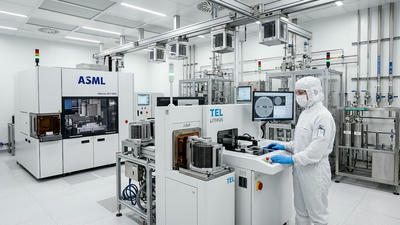
Advanced Packaging Equipment Growth: Outpacing Front-End Tools
The traditional division of semiconductor manufacturing was easy to describe. Front-end fabs created devices on wafers; back-end providers assembled, packaged, and tested them. Equipment purchasing broadly followed the same boundary. A foundry bought deposition chambers and etchers, while an assembly operation bought bonders, molders, and test systems.
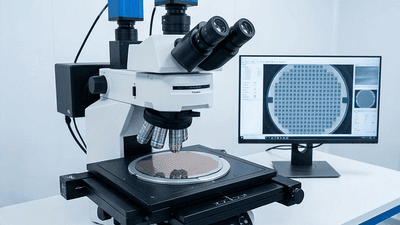
Advanced packaging is making that picture less useful. Packaging facilities increasingly need processes associated with wafer fabrication, including lithography, thin-film deposition, etching, cleaning, and precision measurement. At the same time, customers are deciding which integration steps to keep internally and which to assign to specialist partners.
“Outsourcing front end tools” therefore describes two connected developments: the use of wafer-processing technologies in packaging, and the outsourcing of manufacturing steps that require those technologies. It does not mean that outsourcing ownership of equipment is itself the universal business model. The central theme is convergence—between process technologies, equipment suppliers, and manufacturing responsibilities.
Packaging Is Becoming a Process-Integration Business
Advanced packaging connects multiple components in ways that can improve system performance without requiring every function to reside on one monolithic die. That integration introduces demanding interconnect, alignment, surface, and material requirements.
Some operations resemble familiar assembly work. Others involve patterned layers, deposited films, controlled removal, and wafer-level processing. The result is a manufacturing flow that combines capabilities previously discussed in separate equipment categories.
From a packaging manager’s perspective, this is a change in operating complexity. A line needs more than accurate placement and dependable encapsulation. It may also need disciplined control of film properties, pattern geometry, contamination, and surface preparation.
For equipment suppliers, the same change creates opportunities beyond their historical customer base. A technology developed for wafer processing can become relevant to packaging—but only if it fits the new application.
Which Front-End Technologies Are Moving into Packaging?
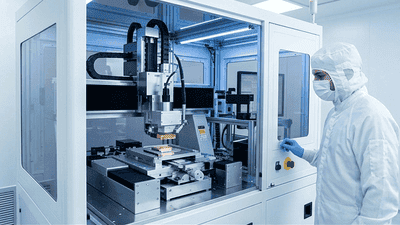
Advanced package interconnect formation can involve lithography, deposition, etching, cleaning, and inspection. These processes introduce new requirements for both foundries and packaging providers, rather than belonging exclusively to one side of the industry.
The overlap is particularly visible in redistribution layers, which route connections between dies and package interfaces. Creating those structures requires a coordinated sequence of materials and patterning steps.
Other integration approaches place greater emphasis on surface preparation, alignment, or bonding. The exact equipment mix depends on the architecture.
This is why advanced packaging should not be treated as a single standardized production line. A fan-out process, an interposer-related flow, and a three-dimensional bonding application can share some capabilities while requiring very different tools and operating conditions.
A Packaging Tool Is Not Necessarily a Repurposed Fab Tool
Equipment overlap does not imply that a front-end system can move directly into a packaging factory without modification. The workpiece, materials, and process requirements can differ substantially.
Packaging operations may involve reconstituted wafers, larger substrates, or panels. Surface topography, handling behavior, and material compatibility can create requirements different from those encountered on conventional silicon wafers.
A tool also needs an appropriate economic profile. Purchasing capabilities far beyond the application’s needs can increase cost without improving useful output.
For suppliers, the opportunity is therefore application engineering. They must adapt handling, process control, throughput, and service arrangements to the packaging customer. The most successful offering is not simply the most sophisticated platform; it is the one that performs the required operation reliably and economically.
Why Customers Outsource These Manufacturing Steps
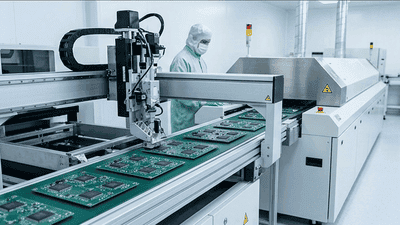
Building an internal advanced packaging operation requires equipment, facilities, engineering teams, qualification, and continuing process development. It can be attractive when a company needs close control over strategically important integration capabilities.
Outsourcing offers a different route. A customer can access a specialist provider’s infrastructure and expertise without building every capability itself.
That does not remove the cost of equipment. It changes who invests, operates the tools, and manages production. The provider then needs enough customer demand and operational efficiency to earn a return on that investment.
From a chip designer’s perspective, the decision concerns flexibility, control, and time to production. From a manufacturing provider’s perspective, it concerns utilization, differentiation, and the ability to serve multiple programs without excessive customization.
Foundries and OSATs Are Taking Different Positions
Outsourced semiconductor assembly and test companies, or OSATs, specialize in manufacturing services after wafer fabrication. Foundries can also participate in advanced packaging, particularly where integration is closely connected to their device and interconnect technologies.
The division of responsibility can therefore vary. A foundry may perform some integration steps while a packaging partner completes subsequent assembly and test. Another program may place more of the flow with an OSAT.
Neither arrangement should be assumed universally. The decision depends on technology, customer requirements, intellectual property, available capacity, and the maturity of the process.
For equipment suppliers, this creates a broader commercial map. Similar process capabilities may be purchased by different customer types, but the purchasing criteria and support requirements can differ.
The Equipment Opportunity Has Two Growth Drivers

Advanced packaging can support equipment demand through increased production volume and through greater process content per package.
The first driver is familiar: more output requires additional capacity when existing tools cannot absorb the demand. The second is architectural: a new package may introduce operations or tighter requirements that require different equipment even before production volume rises substantially.
These drivers should be examined separately. A more complex flow can increase equipment spending, while better throughput or higher utilization can moderate the number of additional systems required.
For investors, this prevents a common forecasting shortcut. Packaging revenue growth is not an automatic multiplier for every equipment category. The relevant relationship runs through the actual process sequence and the capacity needed at each step.
Deposition and Etching Gain a New Customer Context
Deposited films and patterned structures can be important to advanced package interconnects. This creates opportunities for suppliers whose core expertise historically centered on wafer fabrication.
However, the application may require a different balance of materials compatibility, uniformity, process speed, and cost. A packaging customer can value these attributes differently from a leading-edge logic fab.
The commercial challenge is to translate technical expertise without carrying unnecessary complexity into the new market. Product development needs to reflect the customer’s process rather than assume that front-end specifications are automatically optimal.
For established suppliers, the advantage can be deep process knowledge and engineering infrastructure. For packaging specialists, it can be familiarity with unusual workpieces, factory integration, and application-specific economics.
Lithography Expands Beyond Transistor Patterning
Packaging lithography patterns features serving interconnection and integration rather than directly defining every transistor structure. That difference affects the required exposure, alignment, and handling capabilities.
The equipment must work with the relevant materials and surfaces. It may also need to support substrates or panels whose characteristics differ from standard wafers.
From a production manager’s perspective, throughput and alignment need to be balanced with usable process coverage. A fast system that cannot handle the intended workpiece does not provide effective capacity.
The opportunity is therefore broader than selling another stepper. It includes coating, development, handling, measurement, and the software required to connect patterning results with subsequent manufacturing decisions.
Cleaning and Surface Preparation Become Strategic
When components are integrated through demanding interfaces, surface condition can influence the result. Cleaning and preparation are no longer peripheral activities simply because they occur within a packaging flow.
The process must remove unwanted material without damaging the structures or creating new compatibility problems. Its effectiveness depends on the materials, geometry, and next operation.
For a supplier, this creates a route to differentiation through application knowledge rather than only equipment speed. For a customer, it creates another step that must be qualified and controlled.
Outsourcing does not eliminate that responsibility. The service provider must demonstrate that its process produces the required condition, while the customer needs enough visibility to understand how the interface affects the finished product.
Inspection Makes Outsourced Production More Manageable
Outsourcing introduces an additional coordination challenge: the customer and provider need a shared understanding of acceptable material and process performance.
Inspection and metrology help establish that understanding. They support incoming checks, process monitoring, and decisions about whether material should continue through the flow.
The objective is not to inspect everything indiscriminately. It is to identify the measurements and defect observations that are relevant to the manufacturing risk.
For equipment companies, the opportunity includes data integration and analysis as well as instruments. For service providers, trustworthy process information can become part of the value offered to customers, especially when several companies share responsibility for the finished package.
Factory Infrastructure Must Follow the Tool Expansion
A packaging facility adding wafer-processing capabilities may need additional utilities, contamination controls, maintenance expertise, and safety arrangements.
The investment therefore extends beyond equipment invoices. Installation, supporting infrastructure, training, and process qualification can influence both the cost and schedule of expansion.
From an operations perspective, the facility needs to support the new processes without destabilizing existing production. That can require changes to material flow, maintenance practices, and engineering responsibility.
For investors, announced capital expenditure should be interpreted accordingly. A larger spending budget does not mean every dollar becomes revenue for a process-equipment supplier, nor does installed equipment immediately become qualified production capacity.
Qualification Is Where Growth Becomes Commercial
An equipment demonstration establishes technical potential. Production qualification establishes whether the system works within a defined manufacturing flow.
Customers evaluate repeatability, handling, materials compatibility, defect performance, and useful throughput. They also need confidence in maintenance and field support.
The process can be especially demanding when several suppliers’ tools interact. A change in one step can influence results elsewhere, making system-level collaboration important.
For equipment vendors, repeat orders provide stronger evidence than initial evaluations. They suggest that a customer has found enough value to expand deployment. For investors, that progression is more meaningful than a broad claim of exposure to advanced packaging.
The Outsourcing Model Creates Its Own Risks
A provider investing ahead of demand can face underutilized capacity if customer programs are delayed. A customer relying heavily on one provider can face concentration and scheduling risk.
Customization can also complicate economics. Equipment configured for a narrow application may be difficult to redeploy, while a shared production line may require careful management of different customer requirements.
These risks do not make outsourcing unattractive. They make commercial arrangements, capacity planning, and technical boundaries important.
The strongest partnerships align investment with credible demand and establish clear responsibilities for qualification, process changes, and quality. Equipment growth is more sustainable when the service model supporting it is economically sound.
How to Read the Investment Opportunity
The most useful analysis connects technology, customer ownership, and production readiness.
- Identify which packaging architectures require additional wafer-processing steps.
- Distinguish equipment purchased by foundries from equipment purchased by OSATs.
- Separate pilot-line evaluations from recurring production deployment.
- Examine the effect of tool productivity on incremental capacity requirements.
- Assess service, infrastructure, and qualification costs alongside equipment demand.
- Track repeat orders and utilization rather than relying solely on expansion announcements.
This framework helps distinguish durable application growth from temporary spending concentrated in a few customer programs.
A Broader Equipment Market, Not a Disappearing Boundary
Advanced packaging is not turning every assembly facility into a leading-edge transistor fab. It is bringing selected wafer-processing capabilities into a different manufacturing context.
That creates opportunities for front-end suppliers, packaging specialists, and service providers capable of integrating the two. Outsourcing can accelerate access to those capabilities, but it also changes who carries the capital and execution risk.
The lasting advantage belongs to companies that convert process overlap into qualified production. The market expands when customers can build better packages reliably—not merely when more front-end-style tools appear on a back-end factory floor.